
Homogeneity Is Comfort. Diversity Is Power.
How uniform thinking breeds failure—and why diversity keeps winning

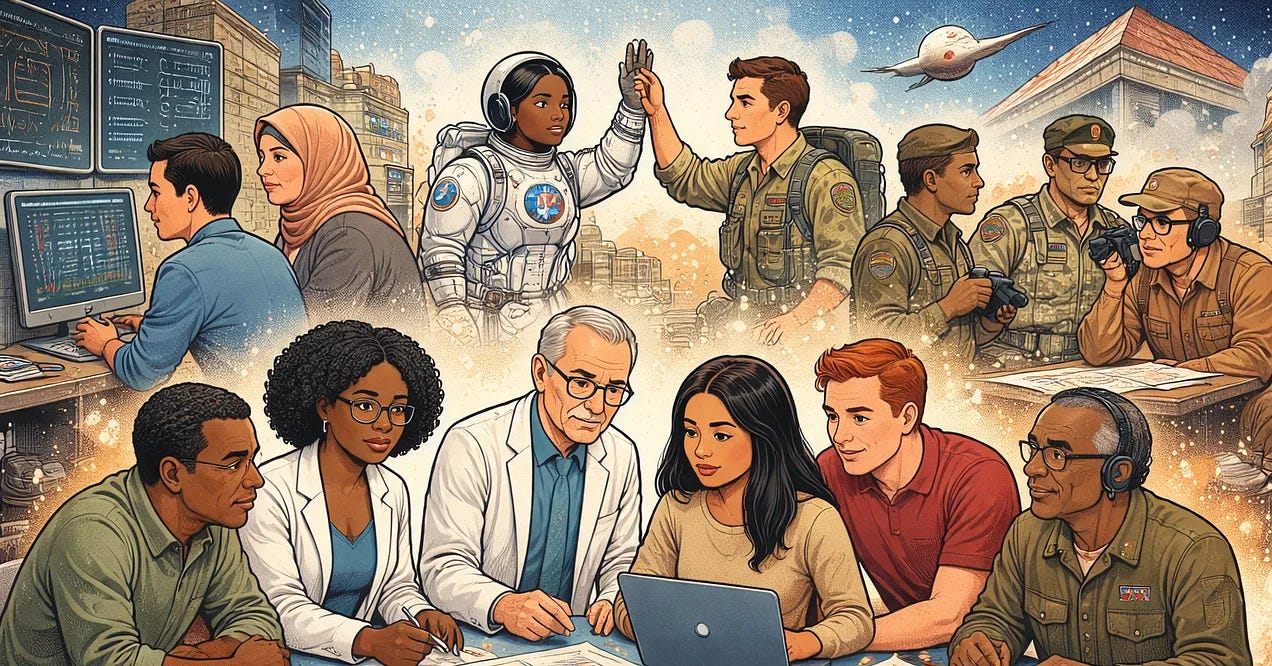
Pete Hegseth’s dismissal of “our diversity is our strength” as the “single dumbest phrase in military history” radiates rhetorical confidence. It is, unfortunately, confidence unburdened by historical literacy. It mistakes unity of purpose—which every functioning military requires—for uniformity of mind, background, and perspective, which no serious military has ever relied upon for long. The charge sounds muscular, commonsensical, and refreshingly contemptuous of fashionable jargon. It is also wrong in precisely the way armchair warriors are often wrong: by confusing discipline with sameness, cohesion with exclusion, and merit with the comforting illusion that talent conveniently appears in only one cultural register. The modern U.S. military did not become effective by purging difference, but by weaponizing it—by recruiting minds, languages, skills, and experiences that adversaries could not predict and institutions could not afford to ignore. To denounce diversity as a distraction is not a defense of excellence; it is an admission of intellectual fragility, dressed up as tradition.
The argument that diversity is a weakness is not merely wrong; it is lazy. It belongs to the long tradition of complaints made by people who mistake familiarity for strength and uniformity for order. It survives not because it explains reality, but because it flatters those already in power by assuring them that nothing needs to change.
History, biology, and war all testify against it.
Diversity is not a moral accessory to be worn on ceremonial occasions. It is not a soft virtue, a sentimental indulgence, or a concession to fashion. It is a hard, unsentimental fact of how complex systems survive. Where complexity increases, homogeneity becomes a liability. Where uncertainty reigns, sameness is a form of blindness.
This is not ideology. It is mechanics.
Homogeneous groups are efficient at one thing: reinforcing their own assumptions. They converge quickly, agree confidently, and fail spectacularly when reality refuses to cooperate. This is why bureaucracies collapse under pressure, why echo chambers rot from within, and why dogmatic movements are forever surprised by the world they insist on oversimplifying.
Diverse groups, by contrast, argue. They interrupt one another. They surface inconvenient facts. They slow consensus and widen perception. This is precisely why they work better. The friction is the point.
Scott Page’s work on collective intelligence demonstrates what history already knew: under conditions of complexity, groups with varied perspectives outperform groups of uniformly “high ability” thinkers who all see the world the same way. Diversity expands the range of hypotheses, increases error detection, and prevents the fatal intoxication of unanimity. These are not virtues. They are survival traits.
Every serious triumph of modern problem-solving has been an exercise in diversity, whether its architects admitted it or not.
The Manhattan Project succeeded because it was an unruly collision of disciplines, cultures, and exiles—many of them refugees from the very ethno-nationalism that worships homogeneity. Physics alone did not build the bomb; metallurgy, engineering, chemistry, mathematics, and dissent did. Uniform thinking would have delayed the outcome by years, with catastrophic consequences.
Bletchley Park did not defeat Enigma with mathematicians alone. It required linguists, chess players, oddballs, women barred from other institutions, and minds that refused to think “correctly.” The code was broken because the team was cognitively impure.
NASA did not reach the moon by excluding those who did not fit the preferred template. Black women mathematicians recalculated trajectories others missed. Software engineers imposed rigor where bravado would have been fatal. Diversity, here, was not representation—it was redundancy against disaster.
The American civil rights movement succeeded not because it was unified in tone or temperament, but because it was strategically plural. Lawyers, preachers, radicals, students, and agitators attacked injustice from every angle at once. Moral clarity without strategic diversity would have failed. History does not reward purity; it rewards pressure applied intelligently.
Nature is not sentimental, and it is not progressive. It is brutally empirical. And it has rendered its judgment.
Genetic diversity is the foundation of resilience. Populations without it collapse when conditions change. Monocultures invite catastrophe. The Irish potato famine was not an act of God; it was an act of uniformity. One blight, one strain, one failure mode—total devastation.
The American chestnut once dominated eastern forests with the quiet confidence of something eternal. Billions of trees stretched from Georgia to Maine, forming one of the great living systems of North America. Then came the blight. Because the population lacked sufficient genetic diversity to resist the fungus, the species collapsed with astonishing speed. Four billion trees reduced to ghosts and stumps in a few decades. Nature delivered the verdict with her usual indifference: monocultures are efficient right up until the moment they become catastrophic. A forest of sameness may look orderly to the casual observer, but it is biologically brittle. Diversity is what gives ecosystems options when disaster arrives—and disaster always arrives.
Hybrid vigor is not a metaphor. It is a measurable effect. Diversity dilutes defects, broadens adaptability, and creates buffers against the unknown. Inbreeding, by contrast, magnifies weakness. This is why closed systems decay—biologically, culturally, and politically.
If diversity were a weakness, evolution would have selected against it. Instead, it made it indispensable.
The irony is that institutions most often invoked by critics of diversity have relied on it deliberately and ruthlessly.
American intelligence services were built by eccentrics, émigrés, scholars, journalists, and outsiders precisely because monoculture produces blind spots. The Navajo Code Talkers created an unbreakable advantage because linguistic diversity shattered enemy assumptions.
Military integration was supposed to destroy cohesion. Instead, it expanded competence, discipline, and recruitment. Modern warfare—cyber, psychological, informational—rewards flexibility of mind far more than rigidity of hierarchy. Cultural fluency is now a weapons system.
Uniformity simplifies command. It also impoverishes perception. And perception is often the difference between victory and annihilation.
The claim that diversity is not a strength usually masks a simpler anxiety: that authority will have to justify itself rather than inherit itself. Diversity introduces dissent. It questions defaults. It reveals that many “traditions” are merely habits that have never been challenged.
This is why diversity is resented. Not because it weakens institutions, but because it exposes them.
When diversity is reduced to tokenism, it deserves criticism. But when it is understood as a property of intelligent systems—as a defense against error, arrogance, and decay—it becomes indispensable.
Homogeneity feels comfortable. It feels orderly. It feels familiar. It also fails—repeatedly, predictably, and at scale.
Diversity complicates coordination but deepens understanding. It slows consensus but strengthens outcomes. It is not a guarantee of wisdom, but uniformity is a guarantee of blind spots.
This is not a plea for kindness or inclusion. It is a statement of fact.
In every arena that matters—science, warfare, medicine, innovation, and survival itself—heterogeneity wins. Homogeneity loses.
And it always has.
Further reading
Cato Institute – “Immigrants Have Enriched American Culture and Enhanced Our Influence in the World.” (Daniel Griswold, 2002) - link
George W. Bush Presidential Center – “Immigrants Put America First: In Coming Here, They Affirm Our Values.” (Carlos Gutierrez, 2017) - link
National Bureau of Economic Research – “The Outsize Role of Immigrants in US Innovation.” (NBER Digest summary, 2023) - link
Institute for Immigration Research (George Mason University) – “Immigrant Nobel Prize Laureates” (report) - link
Vanderbilt University Project on Unity & American Democracy – “E Pluribus Unum. ‘Out of Many, One.’” (Brennan Cegelka, 2021) - link
National Geographic Education – “Biodiversity” (encyclopedic entry) - link
U.S. Geological Survey – “Why is Genetic Diversity Important?” (Abigail Lynch, 2016) - link
Research Outreach – “Strength in difference: Genetic distance and heterosis in China.” (summary of research by Chen Zhu et al., 2020) - link
The Guardian – “Marriage between first cousins doubles risk of birth defects, say researchers.” (Sarah Boseley, 2013) - link
Institut Pasteur – “Human evolutionary genetics: the benefits of genetic diversity.” (Interview with Lluis Quintana-Murci, 2020) (example of heterozygote advantage) - link
Oxford Academic (Oxford University Press) – Inbreeding and extinction risk (scientific consensus statement) - link