
Holy Misery
The Strange Christian Romance with Suffering, Sacrifice, and Self-Erasure

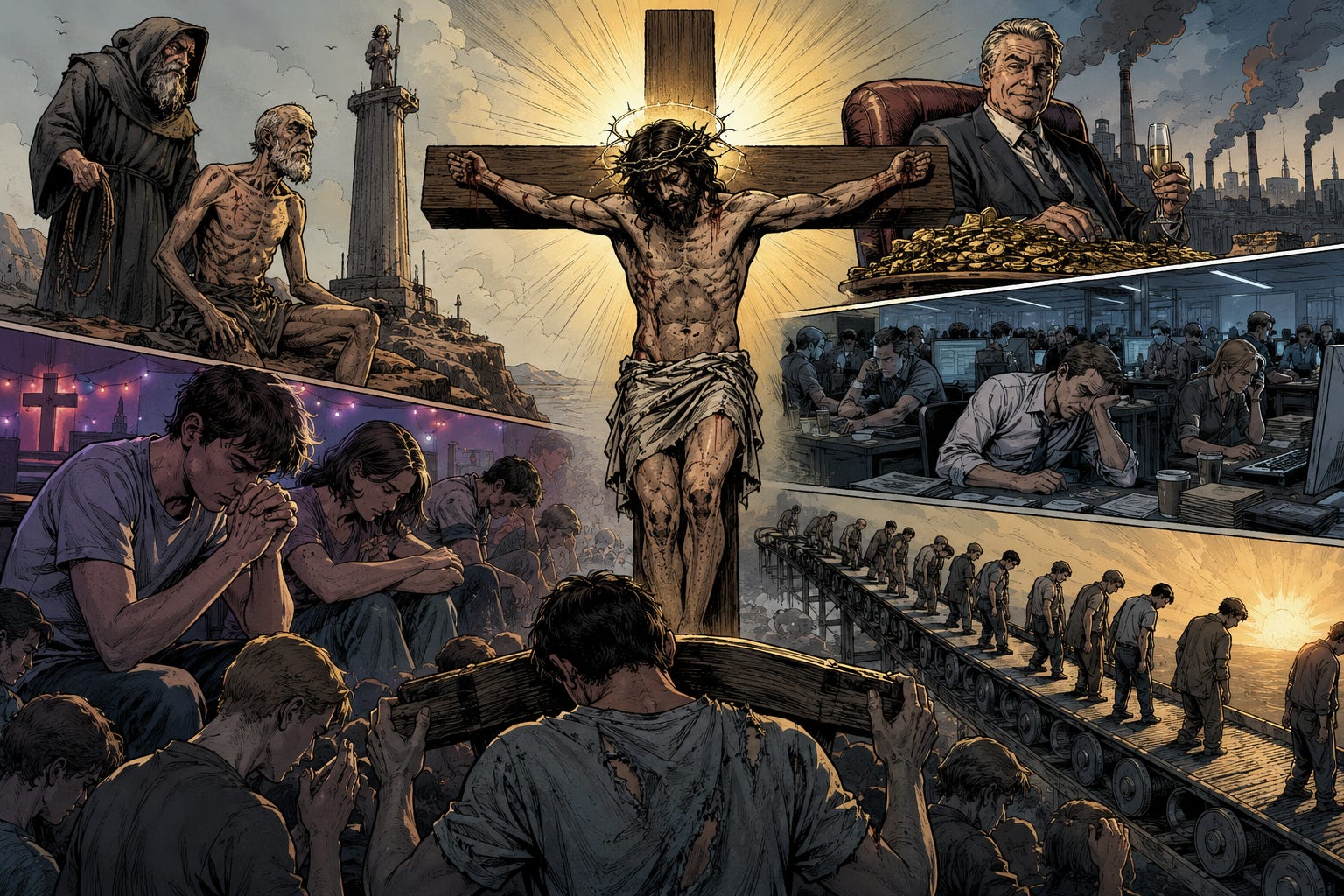
There is a peculiar obscenity at the heart of Christian civilization that many believers no longer notice because they have inhaled it since birth like incense. I first encountered it as a child in Catholic grade school during Lent, when we were forced to wear rough burlap squares around our necks to “share in suffering” as Christ did. The fabric scratched like steel wool and made learning impossible. Naturally, the adults called this character-building. In retrospect, it was an educational philosophy one step removed from self-flagellation. Yet no one questioned it because Christianity has spent centuries teaching people that discomfort is inherently ennobling—that deprivation purifies, agony clarifies, and the wound itself is holy. Only later did I realize how bizarre the spectacle actually was: grown people deliberately making children suffer in the name of spiritual growth.
This is among the most successful psychological operations in human history.
One can forgive ancient people for attempting to find meaning in catastrophe. A mother watching her child die of plague in the fourteenth century did not have antibiotics, labor laws, or modern psychiatry. She had theology or despair. But what becomes less forgivable is the way institutional Christianity transformed suffering from a tragic fact of existence into a positive good—something to admire, cultivate, and eventually weaponize.
The cross ceased to be merely an execution device and became branding.
Christianity inherited from the Roman world a fascination with martyrdom and then amplified it into a cult. The saint was not the one who alleviated suffering but the one who endured it most theatrically. Flesh torn by lions. Bodies burned alive. Ascetics starving themselves in caves. Stylites perched atop pillars like human gargoyles. One reads the hagiographies and realizes that the competition was never about virtue but about pain tolerance. Holiness became indistinguishable from self-destruction.
And once pain becomes currency, institutions immediately learn to mint it.
The martyrdom fetish survives perfectly intact in modern life, only now disguised in secular costume. The overworked employee boasting about eighty-hour weeks. The parent sanctifying total self-erasure. The entrepreneur sleeping under his desk as though burnout were evidence of genius rather than evidence of an untreated labor pathology. The slogans change; the theology remains.
“If it hurts, it must matter.”
This is Christianity’s lingering fingerprint on Western consciousness: the suspicion that joy is unserious and ease morally suspect.
Observe how reflexively people distrust pleasure. A woman enjoying sexuality without shame. A worker demanding leisure. A citizen insisting that healthcare, housing, and dignity should not require spiritual crucifixion first. These are often treated not as healthy aspirations but as moral evasions. The old monastic instinct still whispers beneath the surface: suffering purifies, pleasure corrupts.
One sees this vividly in evangelical purity culture, perhaps one of the most psychologically ruinous systems ever marketed as morality. Human desire—the most ordinary biological fact imaginable—is transformed into a cosmic battlefield. Young people are taught to fear their own bodies as though puberty were demonic possession. Entire emotional lives become structured around guilt management. The result is not virtue but neurosis wrapped in scripture.
And naturally the authorities benefit.
Because a population trained to romanticize suffering is infinitely easier to govern.
The phrase “everything happens for a reason” may be the single most efficient tool of social sedation ever devised. Notice its function. A worker loses healthcare? A child dies of leukemia? A family is crushed by debt? Rather than provoking outrage, investigation, or revolt, the event is dissolved into metaphysical vapor. “God has a plan.” Translation: do not examine the machinery.
It is theology functioning as chloroform.
The truly grotesque aspect is how neatly this logic preserves existing hierarchies. The poor are told their suffering makes them spiritually rich. The exhausted are praised for perseverance rather than liberated from exploitation. The abused are instructed to forgive before they are protected. The hungry are promised treasure in heaven while billionaires build tax shelters on earth.
One begins to suspect that the Beatitudes have been repurposed into HR policy.
This is where Christianity merges seamlessly with capitalist burnout culture. The Protestant work ethic—perhaps the most catastrophic collaboration between religion and economics since indulgences—converted relentless labor into evidence of moral worth. Wealth became proof of discipline; exhaustion proof of character. The secular office replaced the monastery, but the logic scarcely changed. The monk denied himself food; the consultant denies himself sleep. Both are informed that sacrifice is inherently virtuous, and both enrich institutions far more than themselves.
Indeed, modern capitalism may simply be Calvinism with productivity software.
The irony is almost unbearable. Christianity began, at least in part, as a moral revolt against empire—a defense of the meek against the powerful. Yet over centuries it evolved into perhaps the most sophisticated engine ever built for teaching the meek to admire their own subjugation.
“Blessed are the poor,” says the preacher from behind a multimillion-dollar pulpit.
One would laugh if the consequences were not so appalling.
And let us dispatch another sentimental fraud while we are here: suffering does not automatically build character. Sometimes it does. More often it builds trauma, resentment, fear, dependency, and silence. Starvation does not make one noble. Childhood abuse does not confer wisdom. Burnout does not create enlightenment. Human beings are not steel in a forge. They break.
A society genuinely interested in morality would seek to minimize unnecessary suffering wherever possible. It would not romanticize preventable misery into a sacrament. It would build healthcare systems instead of prosperity cults. It would provide rest instead of glorifying exhaustion. It would regard joy, love, curiosity, eroticism, art, and leisure not as temptations from virtue but as evidence of civilization itself.
But that would threaten too many power structures at once.
Because a society that canonizes suffering will always find volunteers willing to manufacture more of it. If pain is holy, then alleviating pain becomes spiritually suspicious. The worker asking for humane conditions appears weak. The woman refusing shame appears decadent. The citizen demanding justice appears impatient with divine timing.
Thus the machine perpetuates itself, lubricated by the blood of those taught to confuse endurance with virtue.
The final obscenity is that this doctrine often survives longest among people already crushed beneath it. The exhausted mother praises sacrifice. The exploited worker glorifies the grind. The lonely ascetic boasts of denial. The victim internalizes the theology because to admit the suffering was meaningless would be almost unbearable.
And there, perhaps, is the deepest cruelty of all.
The Cult of Suffering does not merely demand pain. It demands gratitude for the whip.
The equation is as ridiculous as it is reductive. Christ suffered, therefore we should suffer. Except that he once said, "I am here that ye may have life and have it more abundantly."
Uh, what was that equation, again?